Mount Etna Hike: Tours vs Hiking Mount Etna Without a Guide
Mount Etna is Europe's highest active volcano. It's certainly a must-see during a trip to Sicily. And, there's no better way to explore Mount Etna than by hiking on its magnificent volcanic carpet. As always, there's the age-old question of whether a Mount Etna tour is necessary or whether hiking Mount Etna without a guide is possible.
As is often the case in Sicily, the rules regarding access can be confusing, contradictory and often ignored. In this guide, we're going to explore your best options for doing the Mount Etna hike.
We'll talk about the best Mount Etna hiking tours as well as hiking Mount Etna independently without a guide, and the accessibility rules related to this.
Table of Contents
Hiking Mount Etna With or Without A Guide
Mount Etna is a breathtaking volcano that's been blowing the minds of visitors for many years. Personally, Beck and I spent much of 2022, volcano hiking in Guatemala, El Salvador and Nicaragua in Central America.
After doing around 20 volcano hikes that year, you'd think we'd have been all volcano'd out! But, when a trip to Sicily was calling in the not-too-distant future, Mount Etna, of course, was at the top of the itinerary list. And, rightly so.
From our Central America travels, one thing was instilled in our thinking – you should always hike active volcanoes with a guide. Sounds logical and reasonable, right?
So, admittedly, carrying over that thinking, we thought it best to explore Mount Etna, a very active volcano, with a guide, doing one of the many tours on offer.

Of course, there are many Mount Etna hiking tours to choose from and other tours with less of a focus on hiking. The plethora of options is overwhelming. So, to make life easy for you, we'll go through all of the best Mount Etna tours.
In addition, many people are interested in hiking Mount Etna without a guide. Yes, visiting Mount Etna on your own is possible. But, there are a few caveats and things to know. So, we'll explain the rules and regulations for hiking Mount Etna independently.
Also, we'll explain step by step exactly how to hike Mount Etna without a guide, as it's not so straightforward. Indeed, there are many transport options and varying hiking routes at certain parts of the volcano.
Hopefully, this guide will answer all your questions and concerns about hiking Mount Etna, with or without a guide. Anyway, let's start by looking at Mount Etna hiking tours.
Mount Etna Guided Hiking Tours
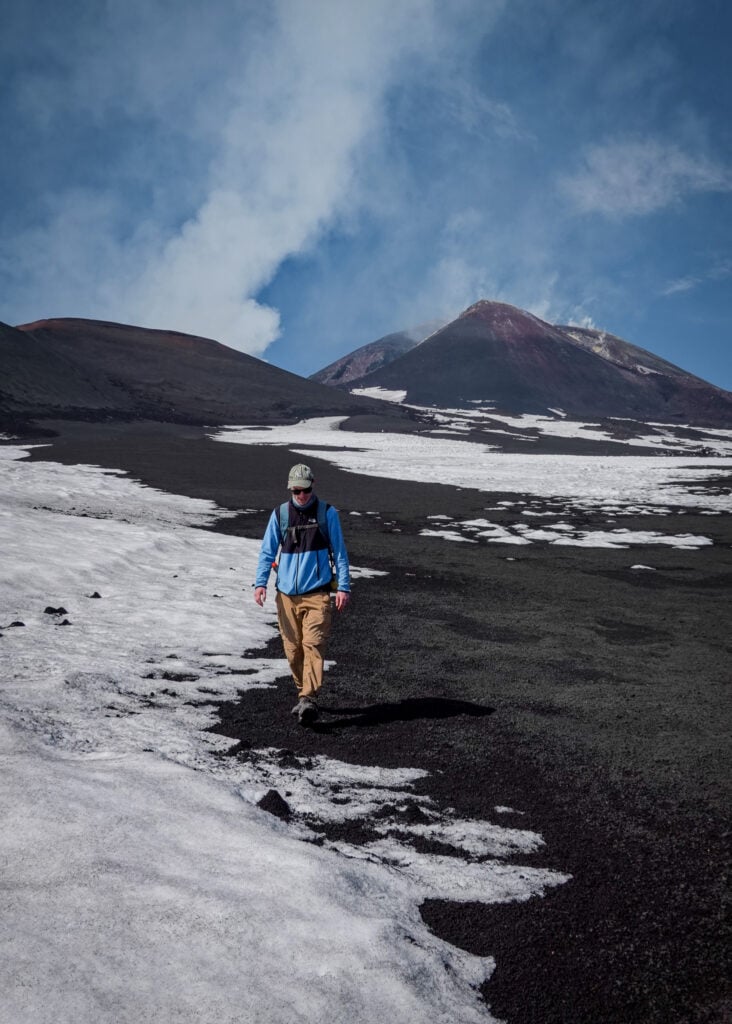
Given Mount Etna is an active volcano, most people choose to do a guided tour. That's exactly what Beck and I did. As mentioned, there are tonnes of Mount Etna tours to choose from.
To help you decide which Mount Etna tour is best for you, we'll go through a few important points to note below. Namely, we'll talk about what part of Mount Etna there is to explore (Etna South vs Etna North).
Additionally, we'll talk about the main differences between doing a Mount Etna tour in the off-season compared with peak season.
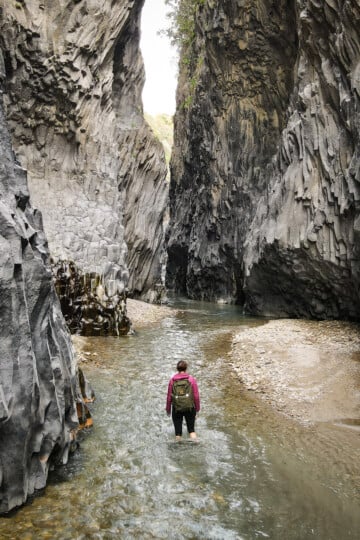
You should also check out the nearby Monti Sartorius and Alcantara Gorge

Visiting Etna South vs Etna North
Mount Etna is a complex volcanic area with over 300 craters! Although there are four (or five, depending on who you ask) main craters, which are the active ones.
There's the southeast crater, the most visited, which you'll explore from Etna South. Because the southeast crater complex is formed by two distinct craters, some people count the southeast crater as two craters, rather than just one crater complex.
You've also got the northeast crater, which can be explored from Etna North. It's possible to do a hiking tour to explore the northeast crater, but it's far less common.
Then there are the Bocca Nuova and Voragine craters, the two central craters that were once a single crater called the Central Crater. Similarly, it's possible to do a hiking tour to explore the central craters, but very few companies offer it.
Most Mount Etna tours explore the southeast crater. So, the vast majority of people will visit Etna South and hike to or near the southeast crater. Indeed, that's what Beck and I did.
To that end, most of the information about hiking Mount Etna, in this guide, refers to hiking Etna South. If you're hiking independently, most will do so from Etna South, and this is reflected in the information in this guide.
If you're the intrepid type, interested in exploring the northeast or central craters, then these tours below may suit you best. Both start from Etna North.
GetYourGuide offers tours for exploring each of these craters. To explore the northeast crater, consider Mount Etna's North Slope Craters Guided Hike Tour. To hike to the central craters, you could do the Mount Etna Central Crater Guided Hike for Advanced Hikers.
Visiting During Off-Season vs Peak Season
If you visit during the peak season in summer (June to August) or even during the shoulder seasons from April to May and September to October, most, if not all Mount Etna tours will be available.
Usually, by April, and certainly by summer, most of the snow atop Mount Etna would have melted, so there are fewer restrictions on accessing the craters.
If you choose to visit in the off-season, between November and March, as Beck and I did, you'll find fewer tours are available. Indeed, many tour operators only offer tours between April and October. So, you'll have fewer options to choose from.
Also, between November and March, because of snow, there are more limitations on activities. For instance, because of snow, on a tour, you're unlikely to hike to or near the summit of the southeast crater, which is approx. 3,340 metres above sea level. You'll likely only hike to around 2,900 metres above sea level, to an area known as Torre del Filosofo.

Mount Etna Hiking Tour Options
Now that you know a little bit more about which Mount Etna craters to visit and the differences between visiting during off-season and peak season, let's look at the most popular Mount Etna hiking tours.
As mentioned, most tours (and the one discussed below) explore the southeast crater from Etna South.
Personally, Beck and I did GetYourGuide's Mount Etna Summit and Crater Guided Trek Tour, operated by Etna Est. We'll talk all about this fantastic tour in the following section – Mount Etna Hiking Tour: Our Experience.
Mount Etna Summit and Crater Tour
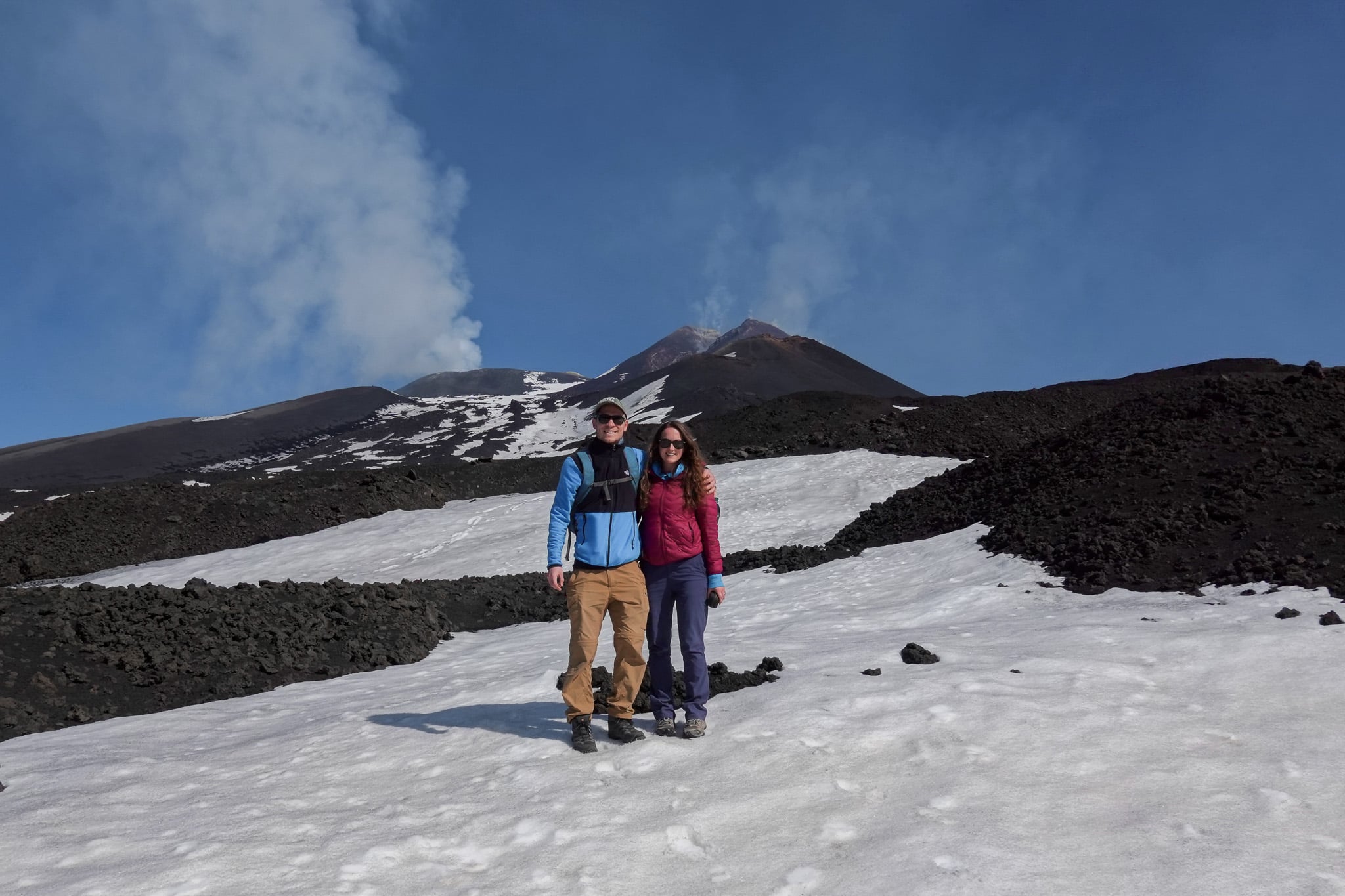
We highly recommend this Mount Etna Summit and Crater Guided Trek Tour that we did. Certainly, it's one of the most popular Mount Etna hiking tours!
Other Mount Etna Hiking Tours
Another popular and similar option is GetYourGuide's Etna Guided Trekking Tour to Summit Craters, operated by Ashàra Volcanological Guides in Sicily.
Please note, that for both of these two hiking tours mentioned above, you'll need to get yourself to Rifugio Sapienza independently by car.
Thankfully, if you don't have a hire car and need to be picked up from Catania, some tour companies offer Catania pick-up and drop-off. GetYourGuide's Mount Etna Cable Car, Jeep & Hiking Tour to Summit, operated by Sicilying S.R.L. is a similar summit hiking tour that offers pick-up and drop-off in Catania.
Best Mount Etna Tour From Catania

The Mount Etna Cable Car, Jeep & Hiking Tour to Summit is the best tour starting from Catania
The other Mount Etna hiking tour option worth mentioning is GetYourGuide's Mount Etna Trekking Trip off the Tourist Path. This is a great option for those who want to do some hiking, but want to avoid the tougher climb to the summit.
Indeed, it's a great tour for exploring the quieter trails at Mount Etna, away from the hordes of tourists doing the organised summit tours. This tour also offers Catania pick-up and drop-off.
Other Mount Etna Tours
There are many other Mount Etna tour options that don't involve hiking or as much hiking. Let's briefly look at these options below.
- From Catania – Mount Etna Sunset Tour: visiting Mount Etna at sunset is a memorable experience. With Catania pick-up and drop-off, you'll enjoy a stress-free and unforgettable trip to Mount Etna.
- Mount Etna Morning or Sunset Day Trip with Tasting: if you like the finer things in life and want more of a cultural experience, then the Mount Etna tour with tastings should be right up your alley. It's possible to choose a sunset tour, so you get the best of both worlds.
- Group Etna Helicopter Tour: after flying our drone at Mount Etna, we can only imagine the delights of seeing an active volcano from the sky. This is the most luxurious tour option and would be a memorable experience. There is also a private tour option.
Best Half Day Etna Tour From Catania

This Mount Etna Morning or Sunset Tour From Catania is the most popular half-day tour, which includes tastings
Mount Etna Hiking Tour: Our Experience
Doing a hiking tour is, above all, the most logical option for exploring Mount Etna regarding safety and accessibility of the crater summits. Below, we'll tell you about our experience doing GetYourGuide's Mount Etna Summit and Crater Guided Trek Tour.
In terms of getting to Rifugio Sapienza, you'll need to drive there yourself. That's because the tour starts at 8:30am and the earliest bus to Rifugio Sapienza arrives around 10:15am. So, public transportation won't be an option. Of course, the most convenient option is to stay at Rifugio Sapienza itself!
Stay at Rifugio Sapienza

Why not stay at the cosy and comfortable lodge at Rifugio Sapienza and explore Mount Etna, literally from its base?
As for hiking gear, hiking boots are mandatory. If you don't have hiking boots, the guide will give you a pair. This is included in the price of the tour. You'll also be given a helmet, which no one usually wears. But, you'll need one with you to do the tour.
Our Tour Begins But With Access Restriction
At around 9am, you'll walk from near Rifugio Sapienza up to the Mount Etna cable car station to begin your journey up the volcano.
Personally, when we visited, the activity at Mount Etna was considerably high. For that reason, at the time of our visit in early 2023 and more recently in 2026, the Sicilian government has imposed restrictions on access to the summit craters. So, even on our guided hiking tour, we were only allowed to go to 2,900 metres above sea level (to Torre del Filosofo).
Undoubtedly, one of the main benefits of doing a guided tour is that you're allowed to access the southeast crater summits at 3,340 metres above sea level. Without a guide, your maximum allowed altitude is 2,900 metres above sea level. Not being able to access the summit craters left us feeling disappointed. But, safety first!
At times when this restriction is in place, it's reasonable to consider hiking Mount Etna without a guide, particularly if you're on a shoestring budget, as you'll essentially reach the same height as a tour. Although, after all, we always recommend hiking an active volcano with a guide due to safety risks.
Mount Etna Cable Car
By riding the Mount Etna cable car, you'll eliminate the need for tedious hiking from Rifugio Sapienza to the Mountain Hut. The catch is, the cable car isn't cheap. Before 2023, the return cable car ticket was around €30 per person.
But, at the time of writing, the prices have risen sharply to €54 per adult for a round trip. As that's the rate set by the Sicilian government, there's no room for negotiation.

Our ride on the cable car was scenic but very stop-start. Perhaps that's because we were the first group to go up that day, and the cable car was just warming up! Anyway, once you reach the Mountain Hut, the Mount Etna walk begins.

Exploring Europe's Highest Active Volcano
From the Mountain Hut, you'll begin your guided hiking tour of Mount Etna. Personally, we had a very knowledgeable and well-travelled guide, who told us loads of interesting information about the volcano.
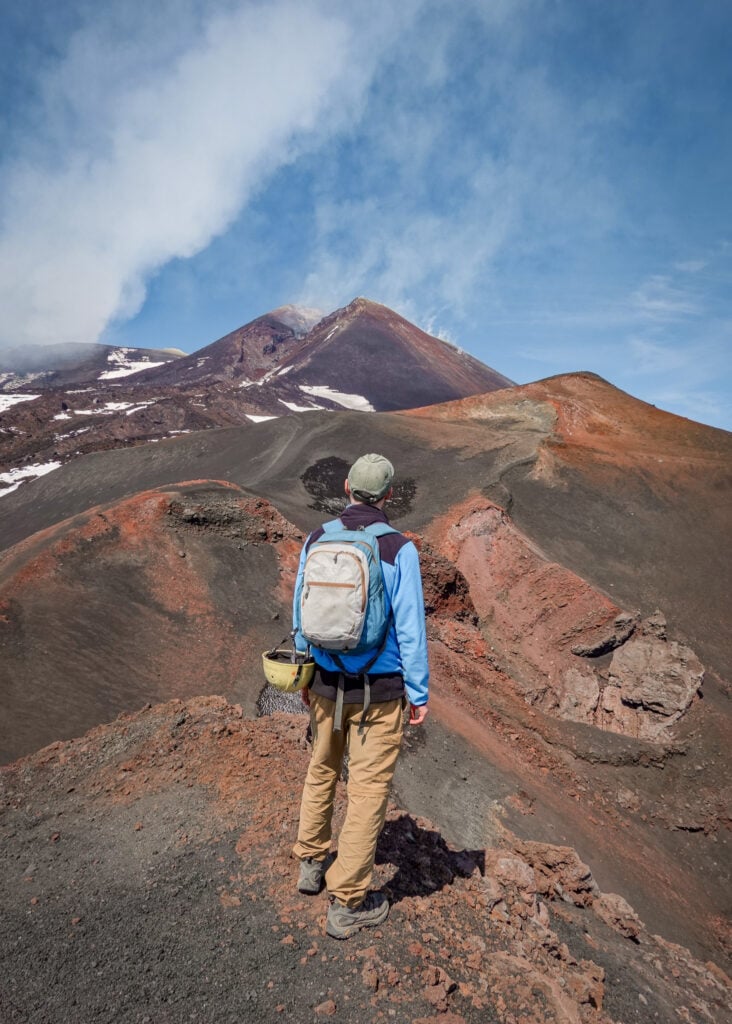
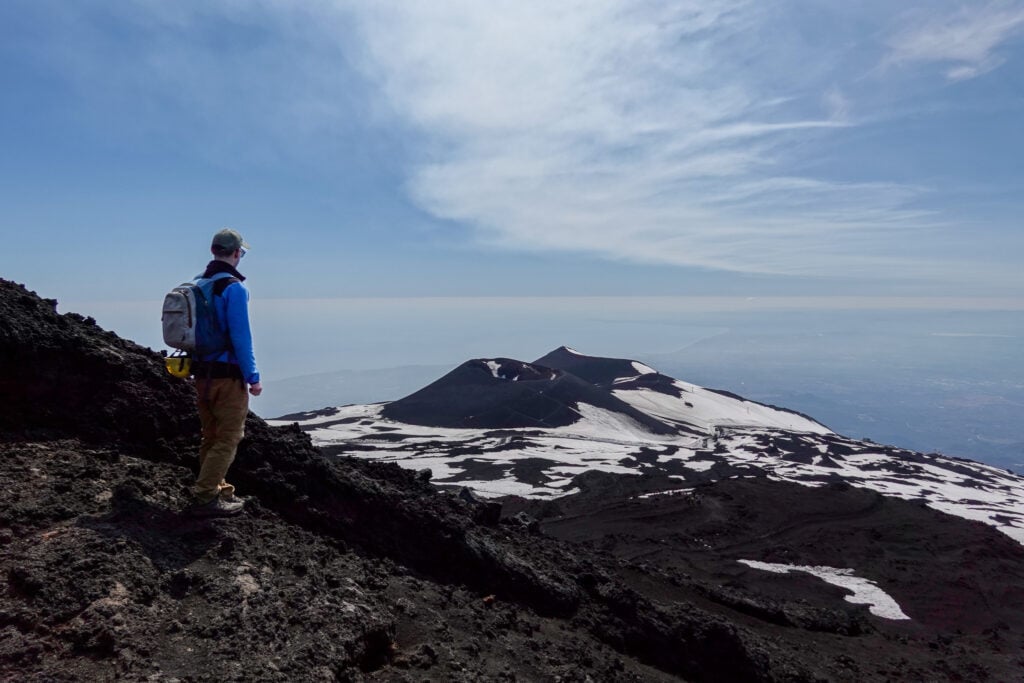
By hiking with a guide, you'll likely take less-defined trails, which are particularly fun and adventurous. After seeing many awesome volcanic features, such as lava fields, lava tunnels and fumaroles, you'll eventually reach the base of the southeast summit. In particular, you'll hike up the edge of a lateral crater to access an awesome viewpoint at Torre del Filosofo.

As mentioned, we couldn't reach the crater summits due to accessibility restrictions caused by the volcano's high activity. But, even so, from the base of the southeast crater, you'll enjoy mesmerising views of Mount Etna. Luckily, we had superb weather. We hope you're also lucky, as a clear day brings exceptional views of the volcano.

After some lunch, you'll then continue your hiking adventure. You'll take an alternate route back to the Mountain Hut, exploring different areas of Mount Etna. Of particular note is Valle del Bove (Valley of the Ox), a vast depression formed during a major eruption of Mount Etna.

Once you reach the Mountain Hut, you'll jump back in the cable car, returning to Rifugio Sapienza. Once you arrive, the tour effectively ends, and you're free to do as you please after returning your helmet (and hiking boots, if you rented them) to the office.
How to Visit Etna On Your Own
As mentioned, it's possible to visit Mount Etna on your own, without a guide. You can do this by using the available transport options (cable car and/or Unimog), then hiking and exploring independently at Torre del Filosofo.
Alternatively, you can avoid using the transport altogether and hike the entire way from Rifugio Sapienza to Torre del Filosofo. Of course, this is the cheapest option (it's free!)
Below, we'll briefly outline step by step how to visit Mount Etna on your own, with minimal hiking involved.
In the section that follows, we'll talk about hiking Mount Etna without a guide or any transport, and what your route options are.
Visiting Etna Without A Guide Using Transport
- Get to Rifugio Sapienza: either drive there yourself or catch a bus. More details on how to get to Mount Etna are available here.
- From Rifugio Sapienza (1,900m) to the Mountain Hut (2,500m): from Rifugio Sapienza, you can catch the cable car to the Mountain Hut.
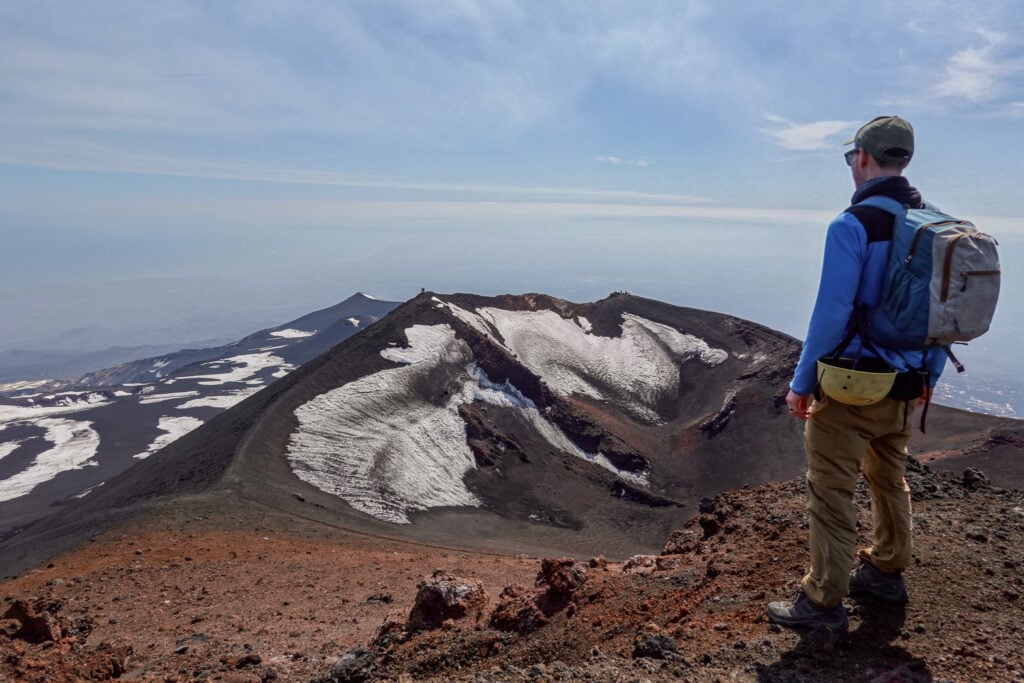
- Mountain Hut to Torre del Filosofo (2,900m): from the Mountain Hut, you can hike up to an altitude of approx. 2,900m, to an area called Torre del Filosofo, featuring epic lookouts of Mount Etna. Alternatively, you can catch the Unimog to a parking area and hike the remaining short distance to Torre del Filosofo. Currently, you can pay €80/adult for the combined cable car and Unimog return trip.
- Return to Rifugio Sapienza: you'll then hike back down or use the Unimog and/or the cable car to descend.

Hiking Mount Etna Without A Guide
Yes, it's possible to visit Etna on your own and hike without a Mount Etna guide, and to avoid using any transport on the volcano. Of course, we don't recommend exploring an active volcano without a guide. If there's an eruption, an unexpected event or something else goes wrong, you'll want to be with a local guide. Period.
But, if your heart is set on hiking Mount Etna independently without a guide, then you'll be happy to know that it's doable. Although the rules around hiking Mount Etna independently aren't so clear-cut.
According to our guide, there has always been a limit as to how high you can hike Mount Etna independently. The limit has always been 2,900 metres above sea level.
As mentioned, you're not allowed to hike beyond this height if you're hiking independently. This means you can't hike to the crater summits (3,340 metres above sea level) without a guide. Certainly, it would be a shame to hike all that way and not be able to hike to the craters.
Of course, some people ignore the rules or even shadow organised tours to reach the southeast summit. Other than the tour guides getting angry at you and discouraging you from doing this, we've never heard of anyone being fined or punished. Of course, this isn't the point. Wandering around the craters of an active volcano, without a guide, is just putting yourself and others at risk.
Anyway, if you're happy to follow the rules and just hike to 2,900 metres above sea level (to Torre del Filosofo), let us talk you through, step by step, how to do just that.
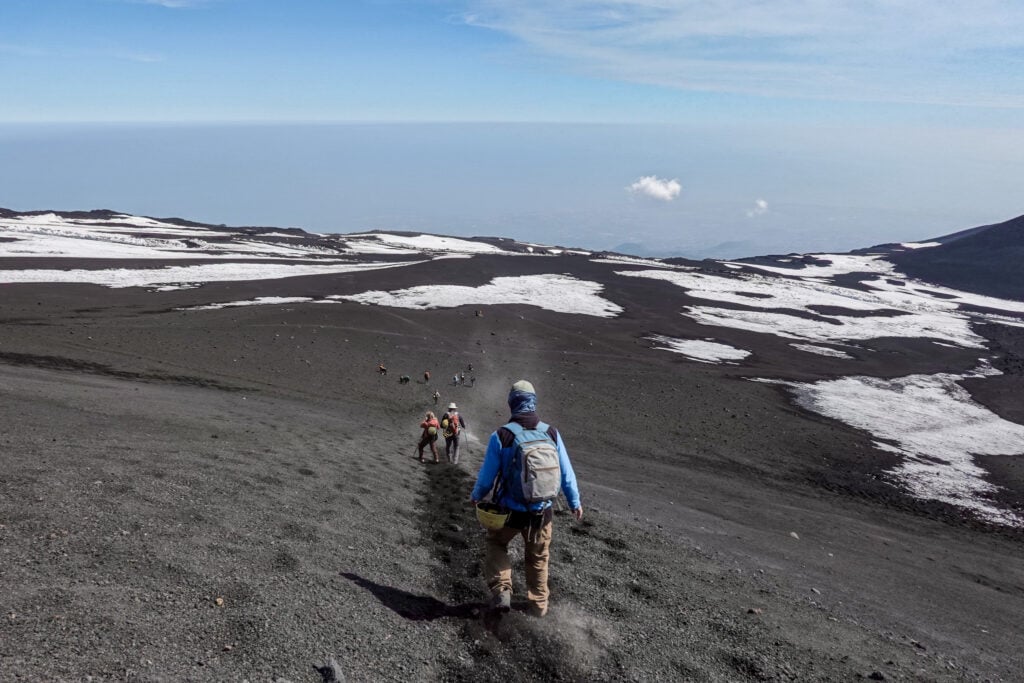
Hiking Mount Etna Without A Guide: Route Options
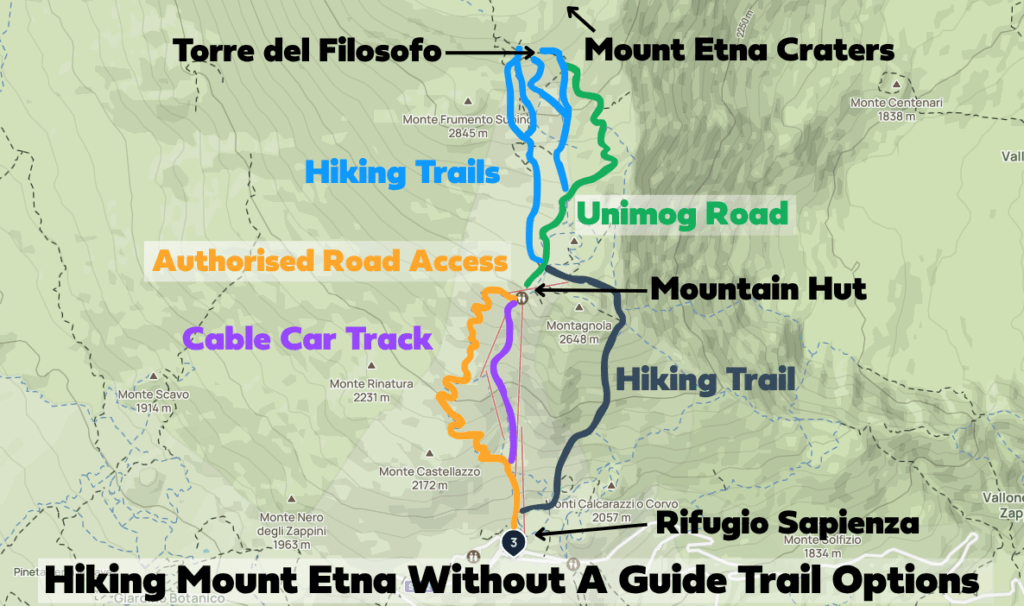
Firstly, you'll need to hike from Rifugio Sapenzia to the Mountain Hut. There are essentially three options. You can walk via any of the following to reach the Mountain Hut:
- Authorised road access
- Cable car track
- Hiking trail
The road is obviously the easiest trail as it's even, but it's also the dullest option. There are also two walking tracks between Rifugio Sapienza and the Mountain Hut.
There is a track that runs parallel to and near the road, essentially under the cable car route (AKA the Cable Car Track). The other hiking trail heads north-east, around the flank of this part of the volcano.
Both tracks consist of scree, which is difficult to walk on. The Cable Car Track is more direct, while the hiking trail is likely more scenic and adventurous.
Whichever option you take, you'll eventually arrive at the Mountain Hut. From there, you have two options to reach Torre del Filosofo, the highest allowable area that you can reach independently. You can use either of the following:
- Various hiking trails
- Unimog road
You can follow less-defined hiking trails from the Mountain Hut to Torre del Filosofo, or follow the Unimog road to the Unimog parking area, which is around 2,700m. From the parking area, the lookouts at the base of the southeast crater (Torre del Filosofo), which are around 2,900m, are nearby.
Best Way to Hike Mount Etna Without A Guide
So what is the best hiking option for exploring Mount Etna independently without a guide? We recommend ascending via the Cable Car Track, then following one of the many hiking trails from the Mountain Hut to Torre del Filosofo.
Then, we recommend descending the same hiking trails to the Mountain Hut, and then continuing via the authorised access road down to Rifugio Sapienza.
Because of the volcanic scree, descending via a hiking trail can be quite difficult and slippery. But doing the entire hike via a road would be tedious.
So, if you ascend via a hiking trail to the Mountain Hut (such as the Cable Car Track, which is more direct), and then descend via the road, you get the best of both worlds – a more enjoyable climb and then an easier descent.
Mount Etna Hiking Maps
For your convenience, we'll provide GPS-guided Mount Etna hiking maps that cover some of the route options discussed above.
These maps don't cover every single possible hiking route, but they nicely exemplify some reasonable options. You may even use a combination of maps, depending on how you want to go about it!
- Cable Car Track Ascent and Authorised Road Access Descent (AllTrails)
- Cable Car Track and Unimog Road (AllTrails)
- Hiking Trail and Other Hiking Trails (AllTrails)
How to Get to Mount Etna
To explore the popular southeast crater of Mount Etna, you'll need to get to Rifugio Sapienza in Etna South. Below, we'll look at your options for getting to Rifugio Sapienza.
Getting to Rifugio Sapienza By Car
The easiest and quickest way to get to Rifugio Sapienza is to drive there yourself. In the peak season, you'll need to pay for parking at Rifugio Sapienza. Otherwise, you may be fined.
During our visit in 2023, the rates were €3.50 for half-day parking and €6 for full-day parking. You'll likely pay €6 for full-day parking (beyond 1pm) if you're doing a hiking tour. But, in the off-season, you don't need to pay for parking as no one is checking.
Of course, confirm this with your guide on the day. Personally, we didn't have to pay for parking in March.
Car Hire

If you don't have your own car, you should hire one using Discover Cars. Personally, we use Discover Cars and highly recommend them for finding your ideal car hire at an affordable price. Booking online is super easy and the free cancellation policy is great.
To find out more about renting a car with Discover Cars, read our Discover Cars review and Discover Cars Insurance review.
Personally, Beck and I picked up our car hire from Catania International Airport. For an automatic car, we only paid around €7 ($7USD) per day!
Getting to Rifugio Sapienza By Bus
It's possible to reach Rifugio Sapienza by bus. The buses depart from Catania’s Stazione Centrale at 8:15am. There's often a single departure, or sometimes two, during the peak season. As mentioned, this bus arrives at Rifugio Sapienza around 10:15am (after stopping in Nicolosi).
Because most Mount Etna hiking tours start at around 8:30 or 9am, taking the bus won't be a viable option if you're doing a tour. But, if you're visiting independently, you could certainly use public transport.
The return bus departs Rifugio Sapienza at 4:30pm. It arrives back in Catania at around 6pm. The trip back is shorter as the bus won't stop at Nicolosi. This bus will set you back around €6.60 per person for the round trip. You buy the ticket on the bus.
Usually, the company running this shuttle bus is AST Buses. During peak season, it's recommended to buy your tickets the day before. Otherwise, at the very least, arrive early on the day, by the latest 7:30am, to guarantee a seat. You can find the AST Buses office here.
Transportation to Rifugio Sapienza Included in a Tour
Thankfully, some tour companies offer Catania pick-up and drop-off as part of the tour. GetYourGuide's Mount Etna Cable Car, Jeep & Hiking Tour to Summit and Mount Etna Trekking Trip off the Tourist Path offers Catania pick-up and drop-off.
Where to Base Yourself For Visiting Mount Etna
Most people visiting Mount Etna will base themselves in Catania. But, we've got an even better idea! We highly recommend basing yourself at the foot of Mount Etna in the charming town of Zafferana Etnea. That way, you'll have sublime views of Mount Etna from your accommodation.
Zafferana Etnea
Personally, Beck and I stayed at Villa Vulcano in Zafferana Etnea. This lodge is an outstanding option for those wanting a budget stay near Mount Etna. Although, it felt more like a luxurious stay (at a super affordable price), given the excellent location, facilities and staff.

We highly recommend avoiding staying in the busy city of Catania and instead staying in the relaxed, quiet, and charming town of Zafferana Etnea.
The benefit of a shorter drive to Rifugio Sapienza is just another benefit of basing yourself closer to Mount Etna. As mentioned, the most convenient accommodation option would actually be staying at Rifugio Sapienza itself.


Catania
Of course, if you don't have a car hire, are catching public transport or are getting picked up from a tour company, you'll need to base yourself in Catania. We recommend checking out Booking.com to explore your accommodation options in Catania.
Mount Etna Facts and Useful Things to Know
Before you visit Mount Etna, there are a few useful things to know. Mount Etna is a UNESCO World Heritage Site. Because of this, Mount Etna is one of the most highly visited tourist attractions in Sicily.
Below, we'll cover some facts about Mount Etna and essential information to help you prepare for your visit.

Mount Etna Altitude and Elevation
The elevation of Mount Etna is approx. 3,340 metres above sea level. The highest altitude of Mount Etna is actually at the southeast crater complex.
There's a mighty difference between Rifugio Sapienza at around 1,900 metres above sea level and the summit of Mount Etna. That's why the cable car and Unimog are there to ease your journey from the bottom to the top of the volcano.
Of course, if you're hiking Mount Etna without a guide, from Rifugio Sapienza, even to the highest allowed limit (2,900 metres above sea level), you'll have your work cut out. That's why the Mount Etna hike difficulty is considered very hard if you hike all the way independently.
FYI – because you'll go beyond 2,500 metres above sea level, altitude sickness is a risk. Sure, most people will be fine. But, if you're feeling a bit rough as you explore Mount Etna, it's possible that you may be experiencing altitude sickness. If you're feeling unwell, make sure to let your guide know.
Mount Etna Weather
At around 3,340 metres above sea level, the weather at Mount Etna can be unpredictable, which is typical for mountain climates.
In winter, you can expect snow to cover most of Mount Etna. Needless to say, it can get well below freezing in winter. And, even during summer, you can expect cold weather atop Mount Etna. Make sure you're prepared – take plenty of layers!
When Is Best to Visit
There isn't necessarily a best time to visit Mount Etna, as it really comes down to personal preference. Most people visit Sicily in summer for the warmest and best weather. But, the weather at Mount Etna is unpredictable.
Even in summer, Mount Etna can still experience bad weather, poor visibility and even thunderstorms and lightning. Also, in summer, you'll have to contend with the huge number of visitors during the peak season.
By the same token, visiting in winter isn't recommended. Because of snow, access to Mount Etna may be severely limited. Perhaps, to avoid the crowds and limited access due to snow, it's best to visit just outside the peak season.
By mid-April (May to be sure), most of the snow has melted and the peak season hasn't begun. Similarly, just after peak season, in September and October, you shouldn't have any limited access due to snow, and the crowds should start to thin. With this in mind, visiting just outside of peak season may be the winning formula!
Of course, you can never guarantee good weather, that high up a mountain, any time of year. So, best of luck when you visit!
Facilities and Amenities
You'll find plenty of shops, restaurants and also toilets around Rifugio Sapienza. At the Mountain Hut, you can also buy food, drinks and souvenirs. There are also toilets at the Mountain Hut, which are convenient to use before setting out on a hiking tour.
FAQs
Below, you'll find the most frequently asked questions about visiting Mount Etna.

How Long Does it Take to Climb Mount Etna?
This depends on how you visit. Most hiking tours that reach the summit take around six hours, with around three to four hours of hiking.
If you're hiking Mount Etna without a guide and without using the cable car or Unimog services, the hike up could take between 2 and 4 hours, depending on your fitness level and the route you take. Of course, the hike down would be much quicker, taking around 1.5–3 hours, again, depending on your level of fitness and the track you descend.
Is the Mount Etna Summit Open?
Not all the time. The Sicilian government will restrict access to the summit, usually prohibiting access above 2,900 metres above sea level, when there is high volcanic activity.
Is it Safe to Hike Mount Etna?
Yes, if you hike with a guide, hiking Mount Etna is much safer. Certainly, hiking independently isn't as safe. And, above all, Mount Etna is an active volcano. So, as is the case with exploring any active volcano, safety is never guaranteed.
Can You Drive Up Mount Etna?
No, the furthest you can drive is to Rifugio Sapienza at Etna South and Piano Provenzana-Linguaglossa at Etna North.
How Often Does Mount Etna Erupt?
Mount Etna erupts fairly regularly. On average, it erupts every 2–3 years.
Is Mount Etna Worth Visiting?
Yes, absolutely. We highly recommend visiting Europe's highest active volcano.
Recent Mount Etna Access Rule Changes
The rules are constantly changing! The Sicilian government sets the rules for cable car pricing and limits on access to the volcano.
In 2023, our guide even mentioned that the limit for independent hikers may be permanently reduced to 2,500 metres above sea level at some point. In theory, this means the Mountain Hut would be as high as you're allowed to go. This hasn't happened yet, but don't be surprised if it does without much notice!
With that said, at times of high volcanic activity, the altitude limit may be temporarily lowered.
As of January 2026, due to recent volcanic activity, new restrictions were put into place. This included limiting group sizes to 10 people. Visitors must also stay at least 200 metres from any active lava flow. In addition, tours are restricted to daylight hours.
In reality, these recent rule changes shouldn't significantly affect your visit. It might just mean that tours sell out quicker. So, make sure to book in advance, especially if you're visiting during peak season.
Please let us know in the comments if any of the information in this guide is incorrect or outdated. After all, pricing, hiking limits, rules and regulations are constantly changing.
Travel Insurance For Mount Etna
Certainly, you'll want travel insurance for doing riskier activities, such as climbing active volcanoes!
Heymondo is one of the best budget travel insurance providers on the market. They provide comprehensive travel and medical insurance that won't break the bank. Whether it's single trip insurance, annual multi-trip insurance or long stay insurance, Heymondo offers affordable travel and medical insurance to suit all of your needs.
Personally, we use Heymondo travel insurance and highly recommend it. To find out more about Heymondo travel and medical insurance, read our Heymondo travel insurance review.
Travel Insurance

Don't leave for your trip without booking travel insurance. We all know accidents can happen and having Heymondo travel insurance could save you thousands of dollars if something goes wrong. Click the button below to receive a 5% discount!
Bonus Tips
- Visit in the off-season: yes, there are fewer tours available to choose from. But, you'll enjoy much quieter hiking trails at Mount Etna. Also, the volcano looks even more exceptional with a dusting of snow.
- Leave no trace: as always, make sure to bring back anything that you take with you onto Mount Etna. It goes without saying that when exploring any natural setting, please leave no trace.
- Do other hikes in Sicily too: for information about all of the best hikes in Sicily, read our Sicily hiking guide.
Will you be hiking Mount Etna with or without a guide? We hope this guide has helped you make your decision for when you visit Mount Etna.